

THE APPARATUS
Five pieces. One body of work.
Joseph Pilates designed the apparatus to teach the body what the floor couldn't. Wood, springs and leather — each piece engineered for a problem the others can't reach. Used together, they do something nothing else does.
WHY CLASSICAL
The apparatus shapes the work it can do.
Classical Pilates apparatus is built to the original specifications — same dimensions, same spring weights, same materials Joseph Pilates worked out a hundred years ago. The way the carriage moves under you, the way the strap pulls in your hand — these aren't details. They're how the body learns.The contemporary versions aren't bad. They're different. They prioritise adjustability, accessibility, and modular comfort — which makes them brilliant in some contexts. For the precise work I do, the classical apparatus is what makes it possible.

i / Reformer
ii / Tower
iii / Wunda Chair
iv / Half Barrel
v / Mat

i / Reformer
The Reformer.
The heart of the system.
A sliding carriage on a hardwood frame. Four springs of varying tension. Real leather straps and loops. A footbar at one end; shoulder rests and a headrest at the other.
Joseph Pilates' original invention — and still the apparatus that teaches the body the most. Footwork. The Hundred. Long Stretch. The full classical order can be worked here, which is why most of every session lives on the Reformer.

ii / Tower
The Tower.
Vertical work. Spinal articulation.
A vertical frame mounted to the reformer, kitted with push-through bars, leg springs and arm springs. Particularly powerful for opening the spine, working overhead strength, and rehabilitating shoulders.
TEACHES
spinal length and overhead strength

iii / Wunda Chair
The Wunda Chair.
Small. Stubborn. Unforgiving.
A compact wooden seat with a spring-loaded pedal underneath. Joe Pilates designed it to double as a piece of furniture — you could sit on it, then flip it over and train.
It looks innocent. It is not. The Wunda Chair takes away the support of a sliding carriage or a frame and asks the body to do the work itself. Brilliant for balance, single-side strength, and the kind of control that translates into how you stand up out of a chair in real life.
TEACHES
control, balance, and unilateral strength

iv / Half Barrel
The Half Barrel.
Curves cut for the spine.
A curved wooden form, sculpted to fit the human back. Sometimes called the Spine Corrector or the Arc Barrel, depending on its exact dimensions.
Small but mighty. The Half Barrel restores spinal mobility in a way mat work alone can't — the shape gives the spine somewhere to go, somewhere to lengthen into. Particularly transformative for opening the chest, restoring side-bending, and undoing the rounded posture of a desk-bound life.
TEACHES
spinal extension, side bending, chest opening
v / Mat
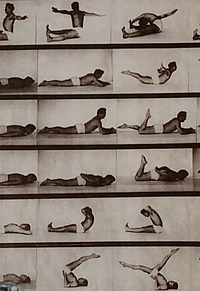
The Mat.
The original method. Nothing in the way.
The work where it all began. Before there was apparatus, Joseph Pilates had a mat and 34 exercises — what he called Contrology.
Without springs to assist or resist, the body has to find its own integrity. The Mat work is the truth-teller of the system — it shows you what's working and what isn't, with no machine to hide behind. It's also the work you can take home with you, anywhere, for the rest of your life.
TEACHES
integrity, control, and precision under your own weight
JOSEPH PILATES
Contrology is complete coordination of body, mind and spirit.
— JOSEPH H. PILATES · RETURN TO LIFE
IN A SESSION
Pilates as a system
Every piece of equipment is chosen for the body in front of me, not worked through as a checklist. But it starts with the mat. Once you understand that, the reformer, tower, chair and barrel stop being separate machines — they become one system, the same principles carried into a different shape.